

A familiar scenario in water odor emergencies: a water plant receives a public complaint — tap water has developed a noticeable earthy or musty smell.
Field personnel arrive on-site immediately. But the real challenge is not whether testing capability exists — it is that laboratory results are not yet available, while the concentration and spatial distribution of odor-causing compounds may still be changing.
Under traditional workflows, water samples must be collected, cold-chain transported, queued at the laboratory, pre-treated, and analyzed by GC-MS…
By the time the test report is issued, the concentration and spatial distribution of odor compounds may have already shifted — and the critical window for source tracing is narrowing.
More and more water utilities are recognizing that responding to water odor events requires both analytical accuracy and timely results.
This has given rise to a new monitoring paradigm — bringing the laboratory to the field.

To address on-site emergency monitoring needs, EXPEC Technology introduces the EXPEC 3500 (Spec: Q) Portable Gas Chromatography-Mass Spectrometry (Portable GC-MS), paired with the EXPEC 210 solid-phase microextraction (SPME) sample preparation instrument, forming a portable analytical solution for field screening and emergency assessment of typical odor compounds in water.
By shifting sample preparation and GC-MS analysis — processes that traditionally rely on laboratory infrastructure — directly to the field, the solution enables the complete workflow of preparation, separation, and qualitative/quantitative analysis to be performed at the sampling site. This eliminates the need for long-distance refrigerated transport and laboratory queuing. The entire process from sampling to monitoring report is significantly compressed, allowing simultaneous multi-point, multi-batch screening to be completed on-site.
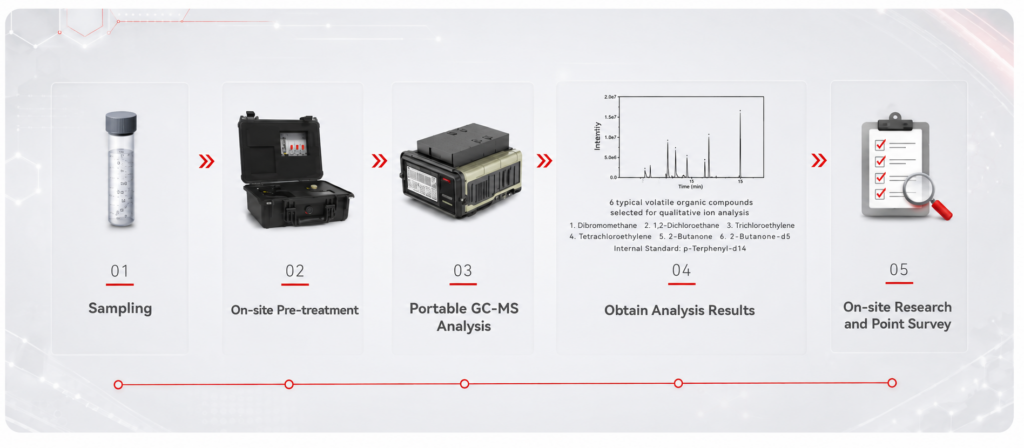
No More Long-Distance Sample Transport
Trace Odor Analysis Completed On-Site, All-in-One
Once field personnel arrive at rivers, reservoirs, or water plant intake points, as little as ~10 mL of water sample is all that is needed to complete SPME pre-treatment, GC-MS analysis, automated data processing, and result output — entirely on-site, without waiting for samples to be shipped back to the laboratory.
The entire workflow — from sampling to results — can be completed in the field, significantly reducing sample transport and lab waiting time, and gaining critical minutes for emergency response.
EXPEC Technology has developed a complete analytical method aligned with GB/T 5750.8-2023 and T/SWSTA 0005-2021 standards based on field application requirements. The method enables stable, accurate detection of 6 typical water odor compounds — including dimethyl disulfide, dimethyl trisulfide, geosmin, and 2-methylisoborneol — providing a solid data foundation for odor tracing and contamination control.
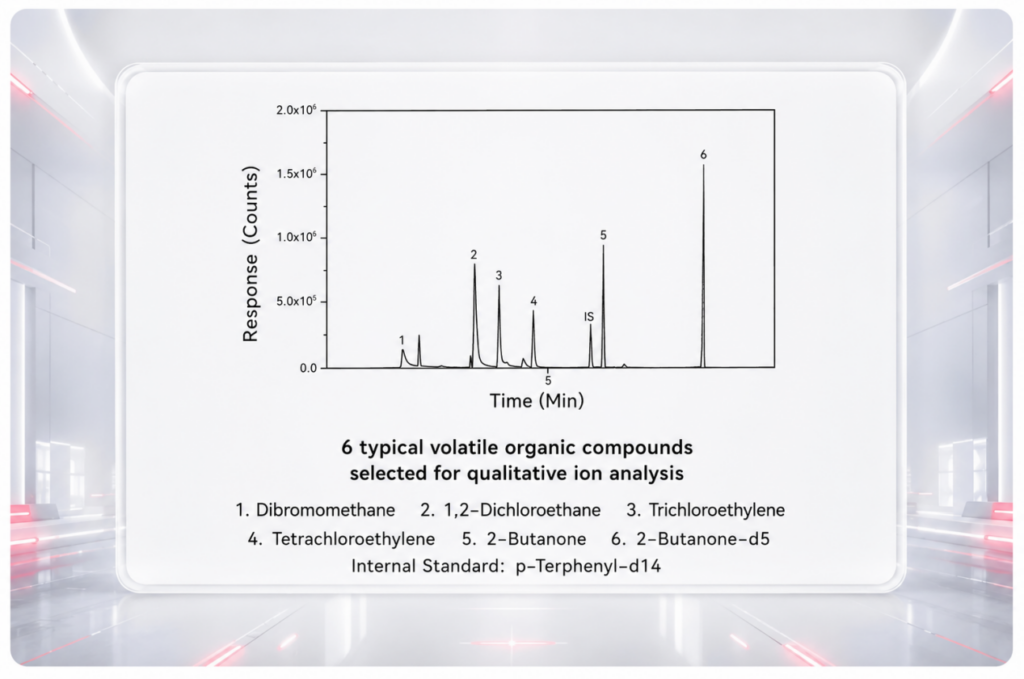
The EXPEC 3500 (Spec: Q) features a miniaturized quadrupole mass analyzer with high qualitative and quantitative performance, providing reliable data support for odor tracing and contamination management. The instrument is highly integrated with a built-in gas supply and power module, allowing single-person carry (handheld or backpack) to reach riverbanks, shallow water points, and other locations inaccessible by vehicle.
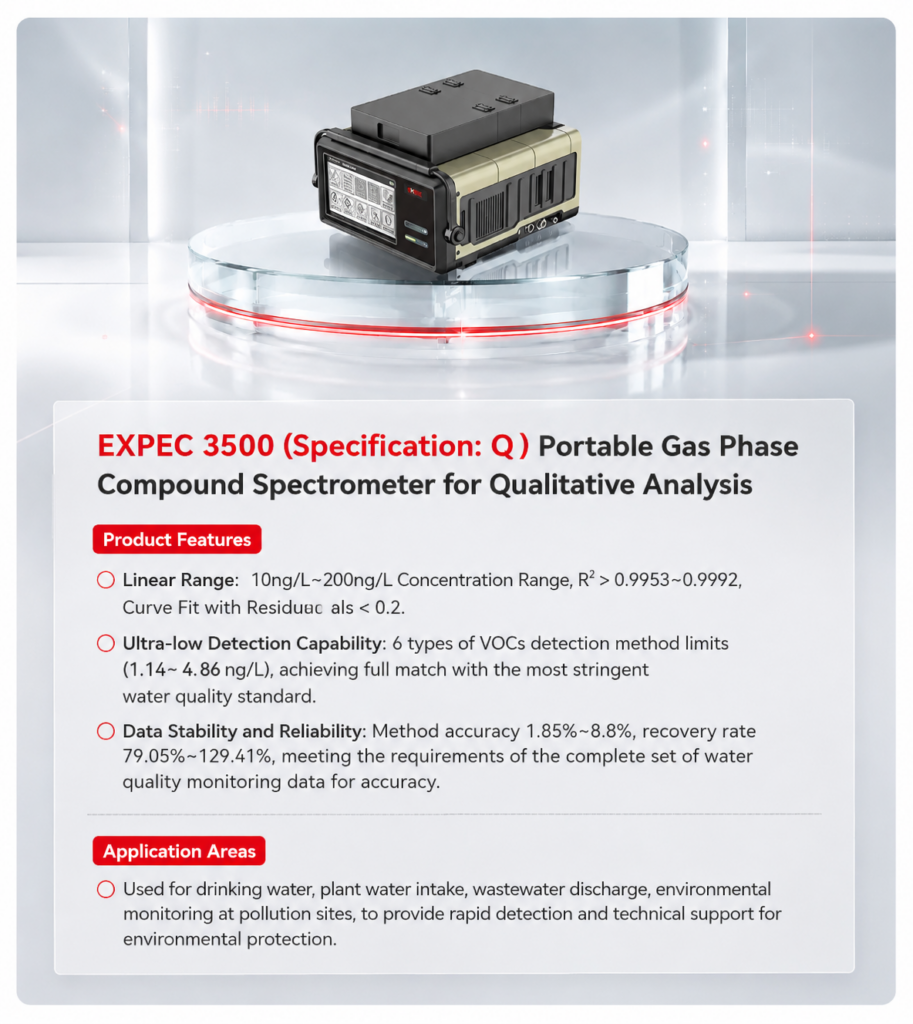
Modular and Flexible Configuration — Simple, Traceable Field Operation
For field monitoring, what truly matters is not just a portable instrument — it is a complete solution capable of supporting real-world field operations.
The value of this solution lies not in simply moving a GC-MS unit to the field, but in integrating sample pre-treatment, instrumental analysis, data processing, and result output into a streamlined, coordinated workflow.
The entire solution adopts a modular design, compatible with SPME, headspace, and purge-and-trap pre-treatment accessories, adaptable to multiple monitoring scenarios including routine drinking water inspection and sudden river pollution incidents. The large touchscreen display comes with built-in standardized odor analysis templates — field operators can launch analysis with a single tap, without complex setup or calibration.
The EXPEC 3500 (Spec: Q) automatically stores all raw spectra and operating parameters, enabling full traceability of monitoring data throughout the process and significantly reducing the analytical workload at the laboratory.
From sampling to reporting, this solution buys critical time for subsequent laboratory verification and emergency response — delivering genuine, deployable on-site analytical capability.
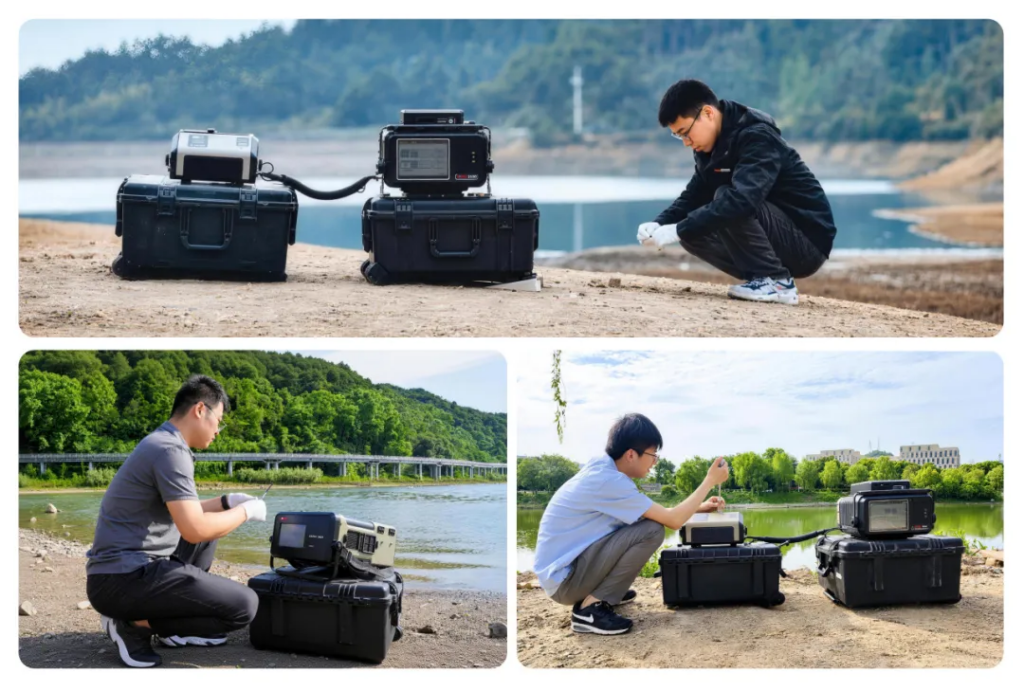
In odor emergencies, getting results one step faster means one step more control over assessment and response.
The EXPEC 3500 (Spec: Q) and EXPEC 210 together bring odor compound analysis capability directly to the sampling site, helping monitoring personnel more rapidly complete site screening, anomaly identification, and on-site assessment — gaining valuable time for subsequent laboratory verification and emergency response.
Delivering data to decision-makers faster. Making every response more evidence-based.
