



Recently, Professor Wang Chongchen's research team at Beijing University of Civil Engineering and Architecture published their latest research findings in Applied Catalysis B: Environment and Energy, a journal widely recognized as a top-tier international publication in the field of environmental catalysis, ranked in the Chinese Academy of Sciences Zone 1 (Impact Factor: 19.7), known for its high acceptance threshold and strong industry recognition. In this study, the team achieved efficient and stable degradation of bisphenol A (BPA) through MOF glass immobilization technology (original article link: https://doi.org/10.1016/j.apcatb.2026.127241).
MOF Glass Immobilization Technology Enables Efficient Bisphenol A Degradation and Long-Term Continuous Operation
Addressing industry challenges such as insufficient water stability of traditional crystalline MOF materials in continuous flow systems and the difficulty of powder recovery, the research team leveraged the plasticity of MOF glass in its molten state, immobilizing ZIF-62(Co) glass onto a three-dimensional porous nickel foam to construct an immobilized catalytic system for peroxymonosulfate activation and BPA degradation.
Experimental results showed that the system achieved 99.9% BPA removal within 15 minutes. Under the same experimental conditions, the apparent rate constant for BPA degradation reached 2.60 times that of the crystalline ZIF-62(Co)@NF/PMS system, resolving the material-level stability challenges that have hindered the engineering application of this catalytic technology.
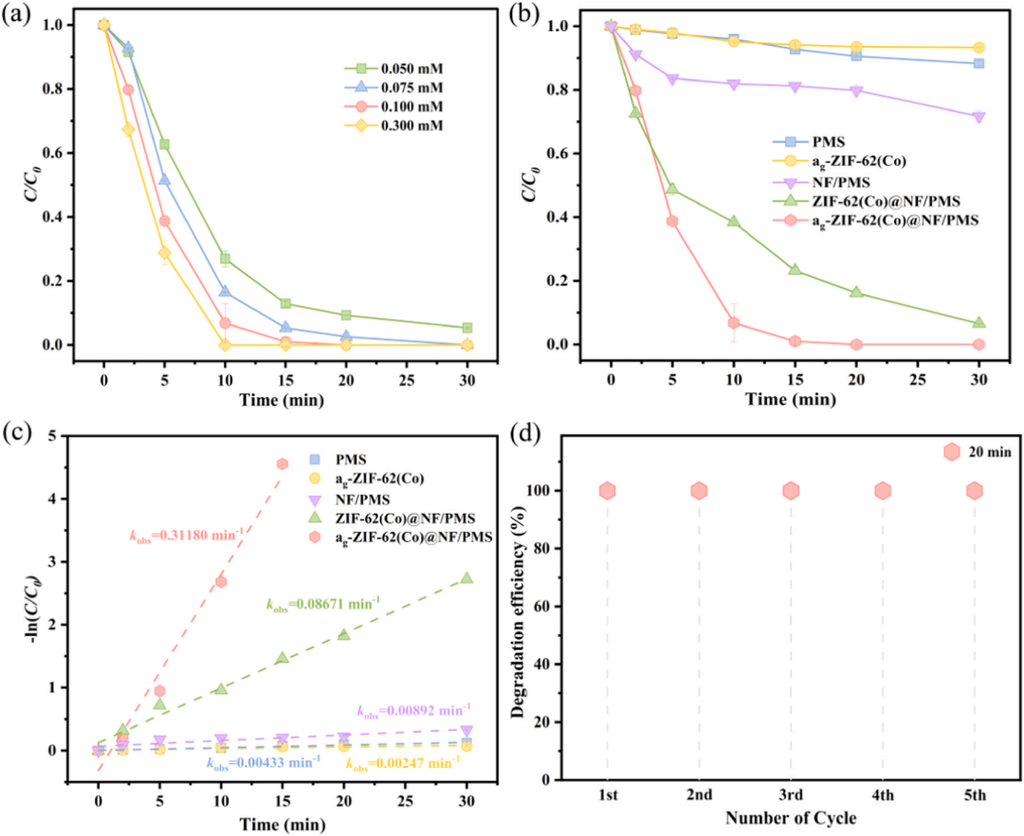
Building on a clear understanding of the reaction mechanism, the team further verified the system's stability over 120 hours of continuous operation and conducted an environmental safety assessment of the post-degradation products, providing comprehensive research support for the engineering application of this material.
EXPEC 5210 LC-MS/MS: Capturing the "Key Evidence" in the Degradation Process
A reduction in pollutant concentration alone can only confirm that the pollutant has been removed. To further reveal the underlying mechanism of the catalytic reaction, it is necessary to track and analyze the various intermediate products generated during the reaction process.
The EXPEC Technology’s EXPEC 5210 LC-MS/MS was used to analyze the intermediate products of BPA degradation, providing the research team with key molecular evidence to propose possible degradation pathways. The team further combined active species experiments, quantitative analysis, and DFT calculations to reveal a synergistic mechanism between radical and non-radical pathways.
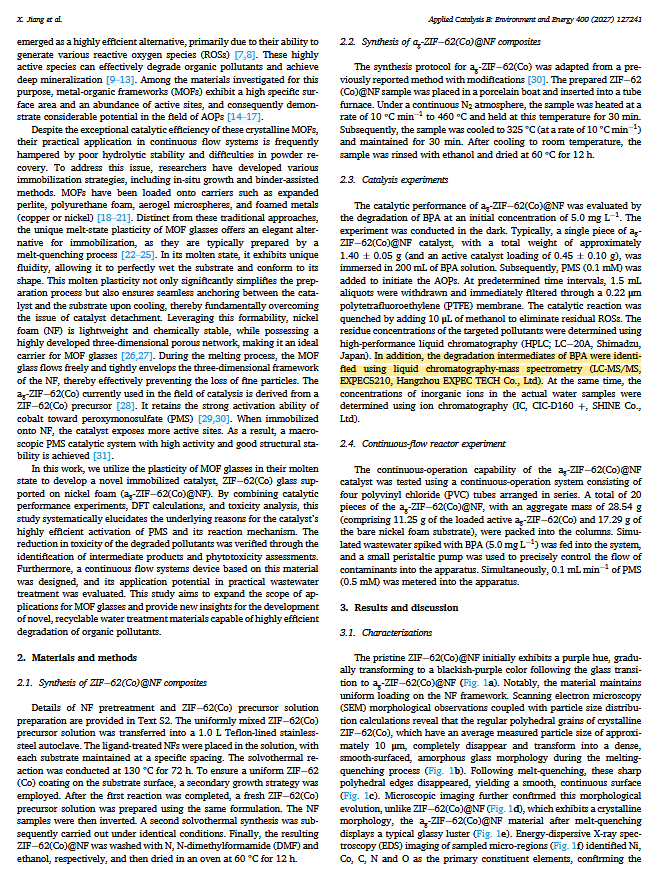
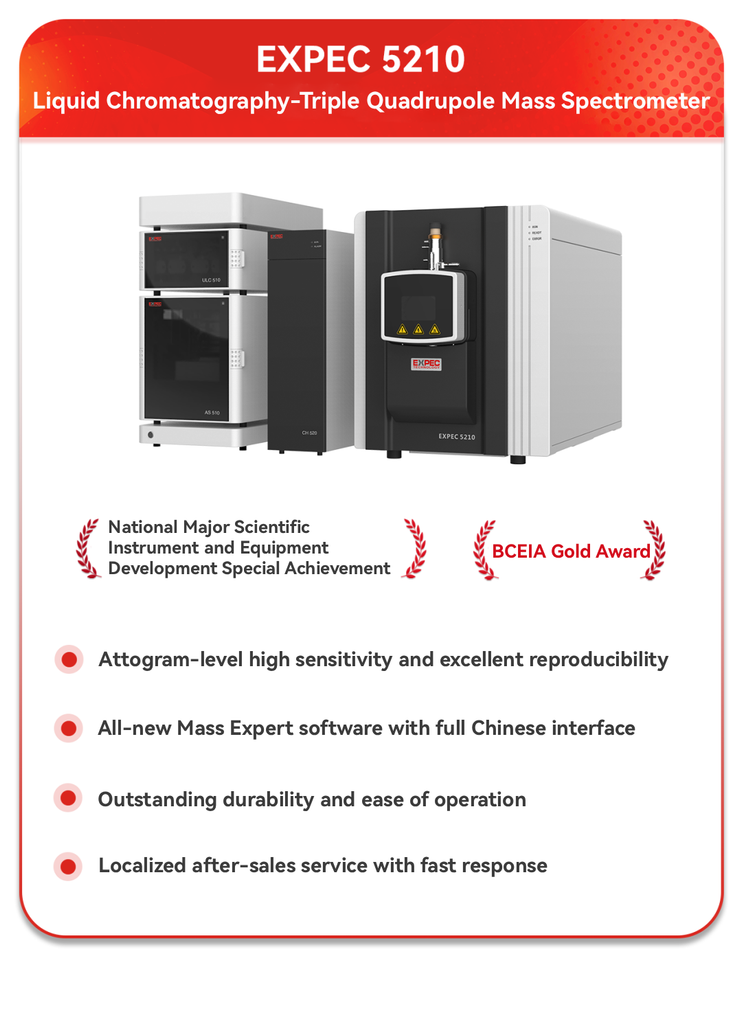
The EXPEC Technology's EXPEC 5210 LC-MS/MS offers outstanding sensitivity, excellent stability, strong scalability, and superior cost-effectiveness. It is widely used in fields such as food safety, medical testing, biopharmaceuticals, and environmental monitoring. The instrument is also equipped with a compound standard library covering thousands of compounds and a rich library of application methods, meeting the diverse needs of mass spectrometry users.
From the precise identification of pollutant intermediates to the in-depth analysis of complex reaction mechanisms, the continuous advancement of scientific research is placing higher demands on the sensitivity, stability, and application capability of analytical instruments.
Looking ahead, EXPEC Technology will continue to focus on innovation in core mass spectrometry technology. Through higher-performance instrument platforms, more comprehensive method development capabilities, and application support systems better tailored to research needs, the company aims to support fundamental research and frontier exploration, providing independent domestic technological assurance for the production of internationally leading, high-level research outcomes.
