



EXPEC 5210 LC-MS/MS supports T6P quantification in a new Molecular Plant study on strigolactone–sugar signaling
Why does a rice tiller bud grow — or remain dormant?
The answer is not controlled by a single hormone or gene.
It also depends on whether the developing bud can access enough sugar.
A recent study led by researchers from the Institute of Crop Sciences, Chinese Academy of Agricultural Sciences (CAAS), together with collaborating institutions, has uncovered an important mechanism connecting strigolactone signaling, sugar transport and rice tiller bud growth.
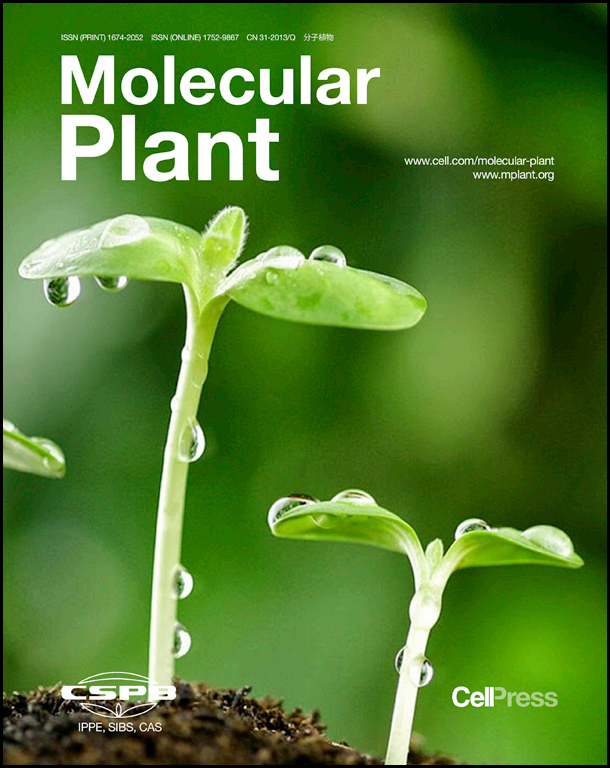
The research, titled “Strigolactones restrict sugar acquisition in rice tiller buds to inhibit their outgrowth through suppressing the expression and polarized localization of two monosaccharide transporters,” was published online in Molecular Plant in August 2026. (https://doi.org/10.1016/j.molp.2026.08.003)
The journal currently has an impact factor of 32.7.
More importantly, the work provides a deeper molecular explanation of one of the key traits influencing rice plant architecture and yield formation.
The question behind rice tillering
Rice tillering plays a major role in determining plant architecture and ultimately influences crop productivity.
Two types of signals are particularly important.
Strigolactones (SLs) are plant hormones known to suppress tiller development.
Sugars, meanwhile, are more than an energy source. They also act as signaling molecules associated with bud growth.
How these two regulatory systems interact has remained an important question in plant biology.
The new study identifies two highly homologous monosaccharide transporters, OsMST3 and OsMST6, as important pieces of this mechanism.
The researchers showed that these transporters facilitate the movement of glucose and fructose from leaf source tissues toward tiller buds, supporting bud outgrowth.
Strigolactone signaling works in the opposite direction.
Through the downstream transcription factor OsTB1, SL signaling suppresses OsMST3/6 expression and counteracts sugar-induced polarized localization of these transporters.
The result is a reduction in sugar allocation to the tiller bud — effectively restricting one of the resources required for its continued growth.
This provides a new layer of understanding of how hormonal and metabolic signals work together to regulate rice architecture.
But understanding signaling also requires measuring metabolism
Molecular mechanisms cannot always be explained through gene expression or protein localization alone.
Researchers also need quantitative evidence of what is happening at the metabolite level.
One metabolite examined in this study was trehalose-6-phosphate (T6P).
T6P is closely associated with plant sugar status and sugar signaling and is frequently studied together with sucrose metabolism.
By analyzing T6P and other sugar-related metabolites in different rice materials, the research team observed significant changes in the T6P/sucrose ratio in tiller buds of strigolactone signaling mutants.
These measurements provided metabolite-level evidence for differences in sugar status between the experimental materials.
And this is where LC-MS/MS became part of the research workflow.
EXPEC 5210 LC-MS/MS for quantitative analysis of T6P
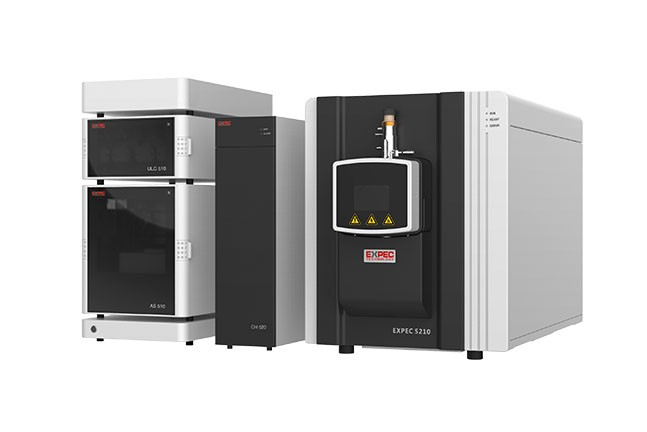
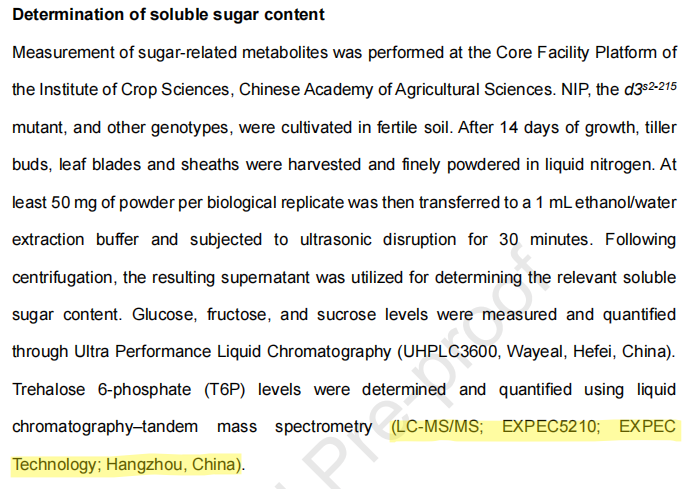
In the study, the EXPEC 5210 LC-MS/MS system was used for quantitative determination of T6P in rice samples.
For researchers working with signaling metabolites, accurate measurement can be challenging.
Target compounds may exist at relatively low concentrations, while plant samples themselves contain highly complex biological matrices.
Reliable quantitative analysis therefore requires analytical systems capable of combining sensitivity, selectivity and stable performance.
The EXPEC 5210 provided quantitative data for T6P, supporting the research team's evaluation of sugar-status changes during rice tiller development and its investigation of the relationship between strigolactone and sugar signaling.
Rather than being an isolated analytical result, this measurement became one piece of a much larger experimental chain involving genetics, molecular biology, protein analysis, sugar transport experiments and metabolite quantification.
That multidisciplinary approach is increasingly characteristic of modern plant science.
From analytical measurement to biological understanding
For analytical scientists, this study also illustrates an important point.
The value of LC-MS/MS in life-science research is not simply its ability to detect a compound.
Its real value appears when reliable quantitative data can be integrated with other layers of biological evidence.
In this case:
Genetics identified key regulatory components.
Protein and localization studies helped explain transporter behavior.
Sugar transport experiments demonstrated how glucose and fructose reach tiller buds.
Metabolite analysis added quantitative evidence of changes in sugar status.
Together, these datasets helped researchers build a more complete picture of how strigolactones restrict rice tiller growth.
Supporting agricultural research with locally developed analytical technologies
The collaboration also reflects a broader development in China's scientific instrumentation ecosystem.
In 2021, the Institute of Crop Sciences of CAAS established a demonstration base for the innovative application of domestically developed scientific instruments.
EXPEC Technology has participated in this initiative with multiple analytical platforms, including ICP-MS, LC-MS/MS, GC-MS/MS, microwave digestion and near-infrared spectroscopy systems.
The cooperation has extended beyond instrument installation.
Application work has included analytical methods for crop elemental analysis, endogenous plant hormones and other agricultural research needs across rice, wheat and maize.
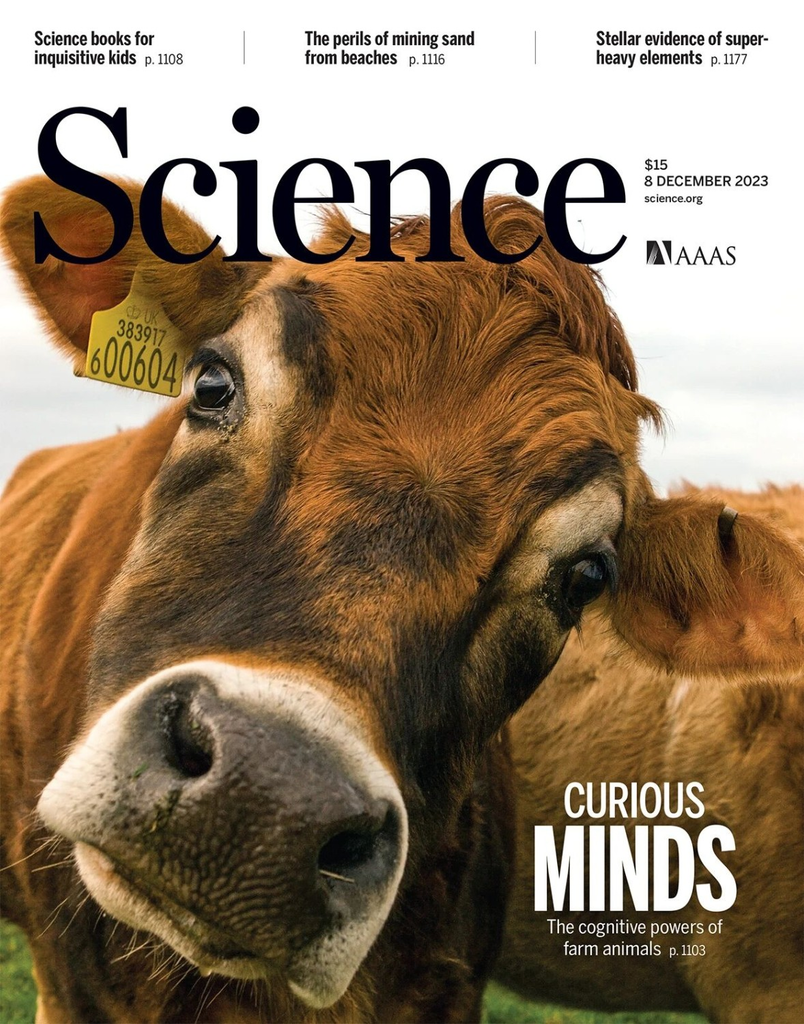
In another example, a 2023 Science study investigating the regulation of iron accumulation in maize grain used the SUPEC 7000 ICP-MS together with a microwave digestion system for iron determination. (https://www.science.org/doi/10.1126/science.adf3256)
These applications point to an important direction for scientific instrumentation:
advanced instruments create the most value when hardware, analytical methods and application expertise work together around real research questions.
Measurement is one part of discovery — but an essential one
Frontier biological research increasingly depends on connecting multiple layers of information, from genes and proteins to metabolites and phenotypes.
Every layer places different demands on analytical technology.
For mass spectrometry, the challenge is clear: provide researchers with quantitative data they can trust, even when targets are present at low levels and sample matrices are complex.
From measuring a signaling metabolite such as T6P to supporting broader plant metabolomics workflows, EXPEC continues to develop LC-MS/MS technologies and application capabilities for agricultural science, life science and other research fields.
Because before a biological mechanism can be understood, many of its smallest changes first have to be measured.
