



Cracking Complex Matrix Interference in 6N High-Purity Rare Earths: ICP-MS/MS Reveals Ultra-Trace Impurities
When material purity reaches 99.9999%, what else needs to be tested?
The answer: impurities.
And ultra-trace impurities at the ppb level or even lower.
In the field of high-purity materials, “N” is commonly used to denote purity. 6N high-purity rare earth typically refers to a main-body purity of 99.9999%, corresponding to a total impurity content of no more than about 1 ppm.
But for quality control of high-purity materials, what truly needs close attention is often the change in a single key impurity element, or even a group of impurity elements.
Their concentrations are extremely low, yet they can affect material performance, batch-to-batch stability, and the reliability of downstream applications.
The purer the material, the harder it is to measure.
High-purity rare earths are commonly used in laser crystals, high-performance permanent magnet materials, semiconductor materials, and high-end equipment.
Similar requirements also exist for other key materials, such as high-purity metals and refractory metals (e.g., tungsten, manganese, hafnium), metal oxide powders (e.g., hafnium oxide), and electronic-grade metal and semiconductor sputtering targets.
For these materials to enter high-end application scenarios, it is not enough to simply “be made pure” — it must also be proven with data that they are truly pure enough.
For materials companies, trace-impurity analysis is directly tied to product grading, process optimization, batch release, and customer qualification.
If measurements are inaccurate, purity is hard to evaluate.
If measurements are unstable, batches are hard to reproduce.
If measurements are slow, the process cannot keep pace with production.
If purity cannot be proven, high purity lacks a reliable basis for entering high-end applications.
01
Very Few Impurities, Very Strong Interference
The greatest difficulty in high-purity rare earth testing comes from complex matrix interference.
Rare earth elements have similar properties to one another, and in mass spectrometry analysis they readily form rare earth oxide ions, hydroxide ions, and polyatomic complex ions that create interference peaks.
These interference peaks can overlap with the mass numbers of the target impurity elements, causing false-positive signals or result deviations.
In high-purity samples, the rare earth matrix content is very high, while the target impurity content may be as low as ppb or even lower — a concentration gap that can exceed tens of millions of times.
It is like trying to hear a needle drop in the distance inside a room full of noisy chatter.
Being able to see a signal does not mean being able to see it clearly.
In complex-matrix analysis of high-purity rare earths, conventional single-quadrupole ICP-MS, when facing strong mass spectral interference from rare earth oxides and hydroxides, often requires column separation, matrix separation, or complex correction methods — a lengthy process that demands considerable method expertise.
But quality control of high-purity materials cannot stop at “being able to measure” — it must also be more efficient, more stable, and more reproducible.
02
EXPEC 7350 Plus Series
Adding a “Triple Barrier” to Impurity Signals
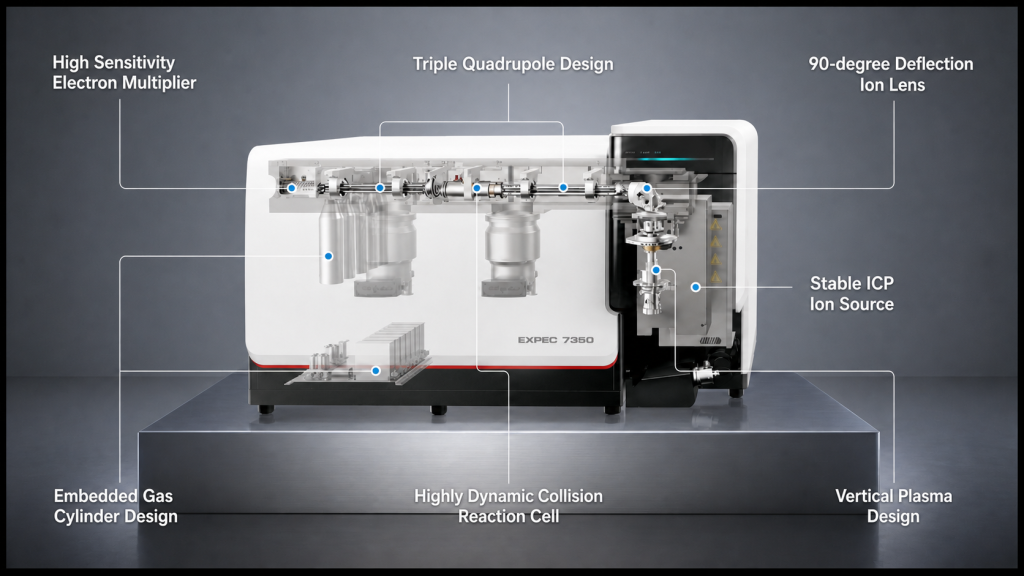
To address this challenge, EXPEC Technology has built an ultra-trace impurity analysis solution for high-purity rare earths and other key high-purity materials, based on the EXPEC 7350 Plus series triple-quadrupole inductively coupled plasma mass spectrometer (ICP-MS/MS).
The instrument offers sub-ppt level detection capability, providing high-sensitivity support for ultra-trace impurity analysis under complex matrix conditions.
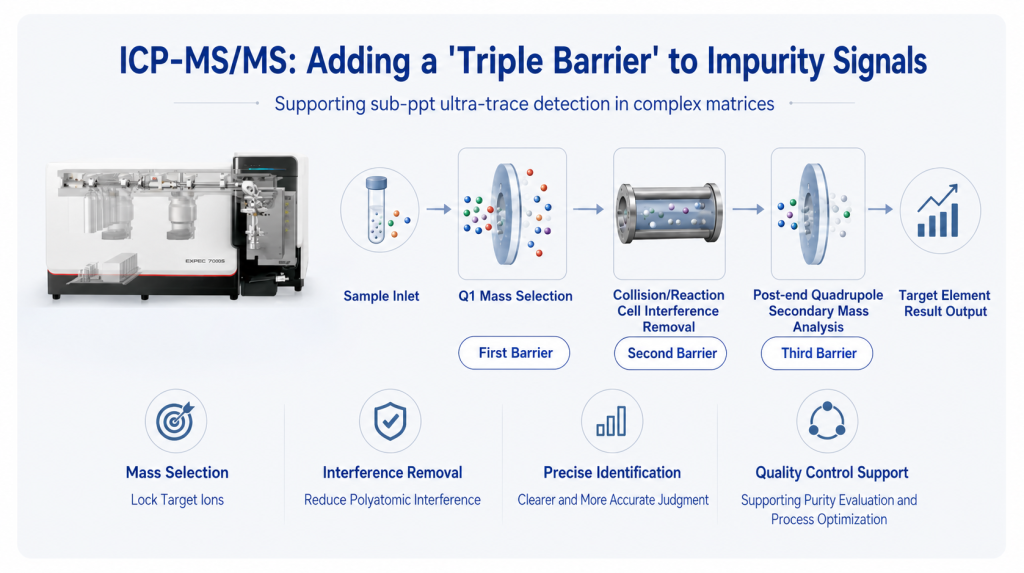
If conventional analysis is like searching for a target signal within a complex matrix, then triple-quadrupole ICP-MS/MS is more like adding a “triple barrier” around that target signal.
First barrier: Q1 mass filtering, which first locks onto ions of the target mass number, reducing the entry of non-target matrix ions.
Second barrier: collision/reaction cell interference reduction, which uses collision or reaction modes to reduce polyatomic ion and other mass spectral interferences.
Third barrier: secondary mass analysis by the back-end quadrupole, which further distinguishes the target ions from residual interference signals.
The core of this solution is not just “seeing lower signals” — it is identifying the target impurity signal more clearly and judging it more accurately under conditions of strong matrix, low content, and strong interference.
In some high-purity rare earth and high-purity material analysis scenarios, this solution can reduce reliance on complex column-separation sample pretreatment steps, improving analytical efficiency and method reproducibility, and providing data support for material purity evaluation, process optimization, and batch consistency control.
To meet the needs of complex-matrix analysis of high-purity rare earths, EXPEC Technology provides not only the ICP-MS/MS instrument platform, but also builds, in parallel, an application methodology system covering sample pretreatment, interference reduction, method development, data analysis, and quality evaluation — helping laboratories improve the accuracy, stability, and reproducibility of ultra-trace impurity analysis.
03
Measured ppb-Level Impurity Results
Supporting High-Purity Rare Earth Quality Evaluation
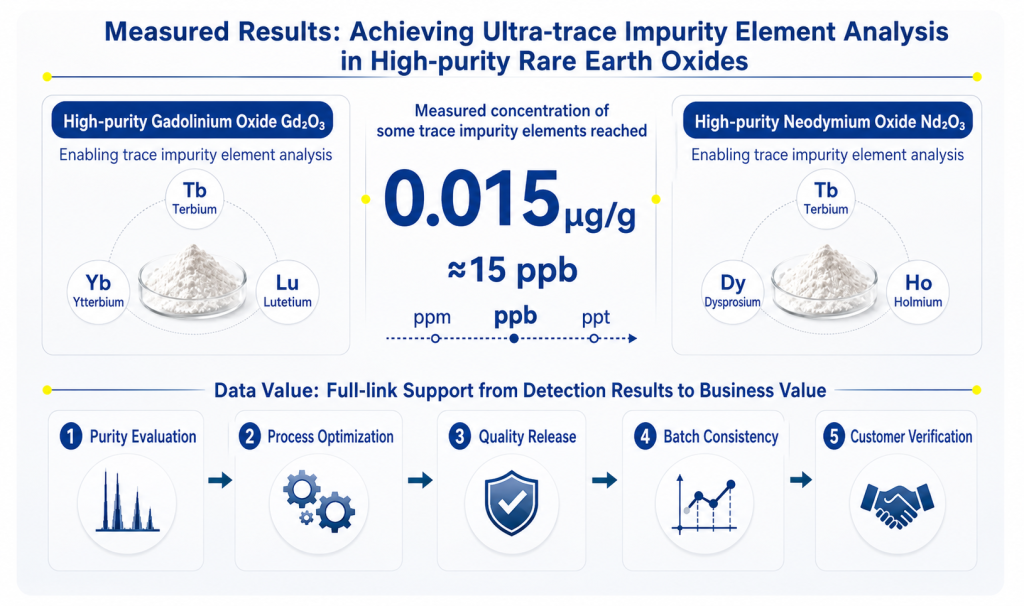
In the analysis of an actual high-purity gadolinium oxide sample, the solution enabled analysis of trace impurity elements such as terbium (Tb), ytterbium (Yb), and lutetium (Lu), with measured concentrations of some trace impurity elements reaching 0.015 µg/g, or about 15 ppb.
In the analysis of an actual high-purity neodymium oxide sample, the solution enabled analysis of trace impurity elements such as terbium (Tb), dysprosium (Dy), and holmium (Ho), providing technical support for impurity identification and purity evaluation under complex rare earth matrix conditions.
These figures are not instrument detection limits, but actual measured impurity results from real samples. They can provide quantitative data support for material purity grading, production process iteration, finished-batch release, batch stability control, and downstream customer qualification.
Purification capability determines how pure a material can be made.
Detection capability determines whether a laboratory can accurately evaluate how pure it actually is.
When material purity reaches 99.9999%, what determines quality is not only making the material purer, but also the ability to go further from ppb-level measured results to identify ultra-trace impurities at even lower levels.
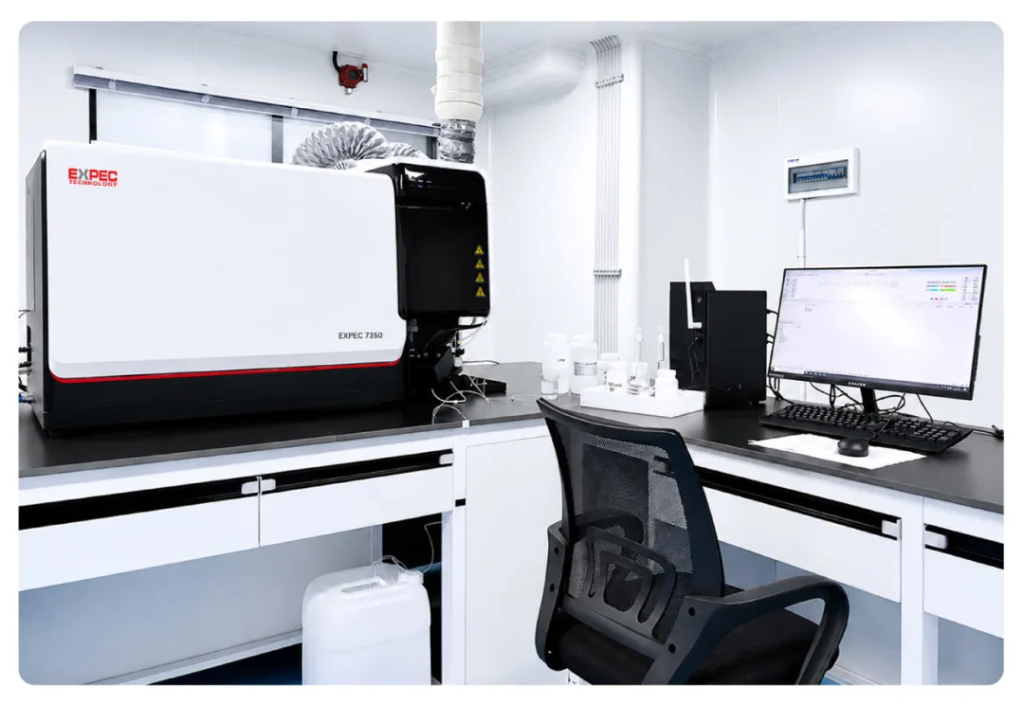
In application validation at the laboratory of a leading rare earth enterprise, EXPEC Technology’s EXPEC 7350 series ICP-MS/MS has already been applied to routine testing and quality control of high-purity rare earths. Actual sample test results show that the solution can perform analysis of multiple trace impurity elements under complex rare earth matrix conditions, providing data support for high-purity rare earth purity evaluation, process verification, and batch quality control.
Looking ahead to higher purity levels, more complex matrices, and more stringent quality control requirements, EXPEC Technology will continue to advance the integration of high-end mass spectrometry technology, application methods, and smart laboratory solutions, providing reliable analytical support for the quality evaluation, process optimization, and industrial upgrading of high-purity rare earths and other key high-purity materials.
